Wednesday, May 20, 2020

"2001: A Space Odyssey" (1968)


“I honestly think you ought to sit down calmly, take a stress pill and think things over.”  HAL, a computerized, artificial  intelligence, getting ready to assert control

“I have made some very poor decisions recently.”  HAL, sensing its doom

The disorientation that I sometimes feel these days, since the health crisis began, is similar to what I experience during the “light show” sequence in Stanley Kubrick’s masterpiece, “2001: A Space Odyssey”.  To those not easily bored, the sequence is astounding.  The effect is like living through the pandemic nightmare.  It comes with no warning nor explanation.  It is off-balancing.  It is overwhelming.  It puts one in a sense of contemplation, not just about what’s happening in front of us, but about its deeper meaning for humanity. There has never been anything like it.  It moves one rapidly and inevitably toward something fearsome and unknown.

“2001: A Space Odyssey” seems to have anticipated, fifty-two years after its release, an entire world on the brink of a seismic change.  Are we, with our preoccupation with technology, about to experience a rebirth?  Or are we, as technology grows beyond our control, about to regress into another Dark Age?   

All of it is told with supreme skill and detail by Kubrick and his crew.  Everything is open-ended; nothing is spelled out. With the anxiety of the new virus holding humanity in its grip, this movie, with all of its ambiguity and slow grandeur, hits us now with a new clarity.  This is a rare example of pure poetry on film, a beautifully meticulous blend of sound and image that carries profound mystery and meaning.

It is one of the most brilliantly designed movies I have ever seen, which goes unappreciated because it is cold, symmetrical, and foreign to us.  But the patterns Kubrick captures with Geoffrey Unsworth’s camera, the wide angles and sharp lighting, and the attention to the most minute detail, have an unprecedented, strange beauty.    Moreover, even to my limited understanding of the properties of physics, the film is the most convincing depiction of a weightless existence I have ever seen.

The film chronicles the history of mankind’s development, from prehistoric days before tools, to humankind’s highest artistic and scientific achievements: space exploration, scored to the heavenly bombast of Richard and Johann Strauss.   It is divided roughly into three parts.

Part One is The Dawn of Man.  Early, ape-like humans, surviving on plants, unable to defend themselves against predators or aggressors, are visited by a strange rectangular slab that appears out of nowhere.  After they contemplate this monolith, they create tools and weapons out of the bones of deceased animals.  They learn to use them for survival and destruction.  When a bone that was used as a weapon is tossed into the air, it becomes a space vehicle, millions of years later, in one of the most celebrated cuts in all of cinema. 

Riding in the space vehicle is Dr. Haywood Floyd, on a mission to a lunar space station to observe a momentous discovery:  scientists have excavated the same monolith.  To preserve secrecy, since the implications of the discovery would be earth-shattering, they create a “cover story” in which an epidemic has swept through the lunar station.  

When I saw the film before, I accepted this “cover story” about an epidemic as a contrived, throwaway plot point.  Now, the scene seems chillingly visionary, like fodder for conspiracy theorists today who are certain that the Covid-19 is a hoax.

Part Two is Jupiter Mission, 18 Months Later.  Two space scientists, Dave (Kier Dullea) and Frank (Gary Lockwood) are on a lengthy mission toward Jupiter, to follow up on strange radio signals being transmitted from the planet.  (We never find out what happened to Dr. Floyd and his team after their hair-raising encounter with the monolith.) This is the longest and most technically stunning section of the film, and also foreshadows the monotony and boredom of the lengthy quarantines so many have had to endure for the last few months. 

These men will be on the ship for a very long time, alone with only each other for human companionship, They stay fit by jogging on a circular walkway, eat processed meals that require pictures of the food they represent, watch TV programs transmitted from earth (with an eight-minute delay), and play chess with HAL. 

HAL is the infamous artificial intelligence computer, programmed to speak to the men, as well as carry out every function of the mission.  HAL speaks in a soft human voice, which is, ironically, more expressive than the actual humans who interact with it.  (He even sings a song, the only music in the film beyond the background score.) 

Suspense is introduced, when HAL claims that a system is about to fail, endangering the two men who venture out to examine it, but which turns out to be false.  Is HAL able to function on his own, and sabotage the mission?  HAL, like the early tools and weapons created by early Man, has become both a means of survival and a means of destruction.

Dave, after his final confrontation with HAL, pursues the mission to Jupiter on his own in Part Three, Jupiter and Beyond the Infinite.  This final thirty minutes has no dialogue, but is the most important section of the film.  It is initially a confusing sequence, but on a deeper level it is the most beautiful, troubling, and profound.

Dave aims his space pod toward the monolith, which is floating in space, and suddenly gets caught up in a blinding vortex of light and sound.  We see cuts to Dave’s expression of anguish as he is hurled rapidly through space and time to an unknown destination.  At one point, his pod assumes the appearance of a sperm-like projectile speeding toward a gigantic, sparkling light.  Geometric shapes divide and revolve like DNA.  Dave passes over strange and brightly colored landscapes, often looking like Peter Max’s psychedelic paintings of the Grand Canyon, or of one of the oceans. 

(It’s no surprise that “2001: A Space Odyssey” was a favorite of young people experimenting with drugs in the late 1960s; MGM studio, savvy to this fact, used an advertising tagline that read: “The Ultimate Trip”.)

The pod lands inside of a strange chamber.  Dave has visibly aged.  The chamber is filled with art and artifacts from Earth: sculptures, lace tablecloths, knitted bedspreads, Renaissance paintings, fine china and glassware.  Suddenly, all of this which is familiar to the viewer seems so strange.  In the rest of the film, design and art were solely functional.  This is the first time that we see art used as decorative, aesthetic, and pleasing. 

It hit me that what made the rest of the film so cold was the fact that art held no importance, beyond the austere beauty of the detailed sets.  Suddenly, we feel at home, because of the familiarities of color, texture, and adornment.  In a world of overwhelming technology, art still matters.  We must not lose sight of that, or move thoughtlessly away from a world without art. 

Dave moves through the chamber and observes himself getting older, in a place where time moves differently.  The eerie echoes of sound are of strange voices, resembling something like a group of people inside of an enclosed zoo exhibit.

Now extremely aged, Dave is in the bed, as the monolith appears before him.  He reaches his hand out as if to touch it with his finger.  The religious overtone is obvious, like the painting on the Sistine Chapel ceiling, of Adam reaching out to be touched by God.  But is the monolith God? Is it knowledge? Evolution? Are they all one and the same?  

Dave, in his final incarnation, becomes a fetal creature, floating in space in a bubble, looking at us with… hope?  challenge?  new beginning for humankind?  In a more recent viewing of the film, will humanity pass into something more innocent? More helpless?  Will the virus kill us off?  Will there be a human afterlife? It is an image to contemplate, in what is one of cinema’s true works of art.

“2001: A Space Odyssey” contains images and technologies that appeared impossibly cutting-edge in 1968, but many of which have come to pass.   There is a seat-back television on the space shuttle. The film is filled with computerized graphics, on control panels and elsewhere. HAL is an early and advanced form of artificial intelligence, more dangerous than the sci-fi robots created to that time. Computerized printouts can be ordered by voice command. There is an early video telephone (amusingly, only 1,90 from space).  And for Frank, one of the lonely astronauts, there is a virtual birthday celebration from his parents, on a screen for him to view.

The film demonstrates the necessity for virtual experiences in extreme circumstances.  But I find today’s over-enthusiastic push for virtual experiences annoying and alarming.  In the absence of meaningful human interaction, thrust upon us by the need for self-isolation, virtual talks and meetings can be emotional lifesavers. 

But for me, nothing virtual will ever suffice.  My world-view, the sharpening of my sensitivities, my humanity and the definition of a good life, have been shaped by opportunities for human interaction and contemplation in places like movie cinemas, coffee shops, art galleries, history museums, concert halls, sports arenas, libraries, fitness centers, restaurants, bookstores,  live theaters, zoos, gardens, lecture halls, guided travel, and so on.

I would not like to contemplate a time in which humankind, out of an abundance of caution, is reborn into a world where these experiences are only available through a computer screen.  We must seek better. I see the face of hope in the final image of “2001: A Space Odyssey”.


Saturday, May 16, 2020

"The Pride of the Yankees" (1942)


There is no baseball right now.  Social distancing has eliminated events that draw large crowds, and sports have been put on hold indefinitely.  The silence from ball parks nationwide is almost as loud as the now-absent crowds. All we have left to fill the void are stories from baseball’s days past, and the players who have become part of American lore.

Lou Gehrig, one of the game’s all-time best-loved players, was born in 1903.  He rose up from the ethnic streets of New York, raised by strict and loving German parents, and in 1923 signed to play first base with the New York Yankees. Gehrig the rookie joined world-renowned players like Babe Ruth, in a lineup that was known as Murderers Row, and later the Bronx Bombers.  

Before long Gehrig, a quiet and unassuming man, thrilled fans with his talent, and was dubbed The Iron Horse for his powerful swing and impressive batting average.  He was a dedicated athlete, who set a record for the most consecutive games played—2,130—a record that stood for 65 years.

In 1939, Gehrig began to suffer unusual physical weakness, leading to a decline in his performance.  With his loving wife Eleanor by his side, he was diagnosed with ALS (Amyotrophic Lateral Sclerosis), a fatal degenerative disease of the nerves and muscles, which was so rare that it became known as Lou Gehrig’s Disease, a term that is used today. On May 2, 1939, he asked his Manager to remove him from the lineup, ending his playing streak.  He left the sport for good, to the sorrow of his teammates and scores of fans.  

July 4, 1939 was declared Lou Gehrig Appreciation Day by New York’s Mayor LaGuardia.  Over 62,000 fans filled Yankee Stadium to pay tribute to this hero, who, in a halting and heartfelt speech to the crowd, declared himself “the luckiest man on the face of the earth”.

Almost two years later, on June 2, 1941, Lou Gehrig passed away. He was 37 years old.

“The Pride of the Yankees”, the affectionate, sentimental biopic of this beloved sports figure, was released in July, 1942, about a year after Gehrig’s death.  His story was so well-known to the nation, and his passing was still so raw and so widely mourned, that audiences coming to see the movie were already aware of the fate of a man they felt they knew, and the film played on this knowledge.  

(Unfortunately, after eight decades, there remains no cure for ALS.)

The film is big and good-hearted, and is a  definite product of its era. It’s like an awkward, gregarious, but terminally ill friend, whose jokes are sometimes corny, who is somewhat politically incorrect, and who is hopelessly old-fashioned; yet who is so eager to please, that you can’t help but like him.  Even when he tries to manipulate you, you give in, because you are aware of his unfortunate end.

Gary Cooper, a supreme actor, plays Gehrig.  It is a gentle and powerful performance, moving nicely from the aw-shucks shyness of the dutiful son and baseball rookie, and his early clumsiness that got him the label “tanglefoot”; to the playfulness of his courtship and marriage to Eleanor; and finally to the stoicism of a young man facing his doom. 

Cooper overcame the fact that he was already too old to play Gehrig; but with help from his lighting cameraman, his skill as an actor, and his resemblance to the real Gehrig, he pulls it off.  Cooper’s inability to throw with his left hand was even addressed by Oscar-winning film editor Daniel Mandell, who devised a way to shoot a reverse image of Cooper throwing right-handed, and then flipping the film in the editing process to make Cooper a southpaw.

Teresa Wright (“The Best Years of Our Lives”) was the reigning sweetheart of American movies in the 1940s.  She is a strong presence in “The Pride of the Yankees”, blending good humor with a convincing gravity which will break your heart. She lost the Oscar that year for Best Actress, but actually won in the Supporting Actress category that same year for “Mrs. Miniver”, playing another strong romantic character.

The film delivers excitement, laughs, heroics, romance, and heartbreak.  It is one of the most effective tearjerkers Hollywood ever produced.  The story alone, told simply and unadorned by dramatics, is enough to make even the most unsentimental viewer swallow hard.  “The Pride of the Yankees”, however, pulls out all the stops, including gut-grabbing closeups, a plaintive and romantic score, skilled performances, and an incredibly moving finale that almost dares a viewer not to dissolve into tears.  

The mythmaking screenplay retains the highlights of Gehrig’s life: from his childhood, breaking windows with his commanding swing; to his school days studying to be an engineer to please his practical mother; to his romance and marriage to his plucky sweetheart Eleanor; and on to his days with the Yankees and his  untimely demise.  Dramatic liberties were taken for the sake of drama, but the heart of Gehrig’s story is alive and authentic.  Yankee players, like Babe Ruth even appear playing themselves, for added realism.  

“The Pride of the Yankees” is the typical 1940s film biography, except that the subject of this story was so current to its time.  It's best to watch it in its historical context,  imagining the feelings of viewers who watched Gehrig’s thrilling career and agonized over his tragic end.  It is hard to imagine Hollywood today producing a film so soon after the death of such a beloved figure in American sports or culture, with famous celebrities co-starring as themselves.  It’s even harder to imagine such a figure of integrity and talent as Gehrig today

As I watched “The Pride of the Yankees” recently, I wept almost the entire time, even as I smiled and laughed at many of the antics on display.  The music got to me.  And the story.  And the perfect gentleness of the main characters as they prepared for a terrible loss.  The finale that recreated the tribute at Yankee Stadium got to me, with Copper’s perfect delivery of Gehrig’s speech, Wright’s mournful tears as she watched alone from the causeway, and the playing of “Auld Lange Syne” as Gehrig, flanked by his current and former teammates, received trophies and plaques. (Fortunately, we are spared a death scene).

But where I really lost it was in the final shot, which was a perfect symbol for Gehrig’s passing. As Gehrig leaves the field to a wild ovation from the crowd, and walks, alone, into the shadows of the dugout, we hear, off-camera, the umpire call out the words, “Play ball!”  Those two words are tragic and hopeful.  I felt so bad for Lou, who knew that life would go on, that he might even be forgotten before he left the stadium.  It’s also full of hope, that life, and baseball, will indeed go on.

But the tears I experienced went deeper than the film itself.

I cried for the characters depicted in the film who loved Lou: his parents, his partner, his team, his fans, his friends in the press box, even the little boy in the hospital who was inspired by Lou to get well and walk again.  I identified with all of them. 

I cried for myself, a gangly and uncoordinated child, thinking that if I watched “The Pride of the Yankees” on TV I would have something in common with the other more athletic boys in the neighborhood.

I cried for my father, a die-hard Cubs fan, who stopped following baseball cold-turkey after the 1980 player’s strike, feeling betrayed by the game that he loved all his life.

I cried for my tomboy little sister, who called this her favorite film when we were growing up.

I cried for my mother, seated on the living room couch, watching this movie with me and weeping openly, while I choked back my tears because boys weren’t supposed to cry at movies.

I think, too, that I cried for the loss of baseball and everything else we’ve lost in this strange time.  It may be a while, but I refuse to believe that all of it is gone forever: the game we all used to know, the lives we knew before this all happened.  I don’t want to give up, and accept that this is how it’s going to be for the rest of our lives.  I want so badly to hear those two words once again.

“Play ball.”


Wednesday, May 13, 2020

"On the Waterfront" (1954)


“Conscience—that stuff can drive you nuts!” –Marlon Brando, as Terry Malloy

One of American cinema's most honored and popular classics, “On the Waterfront” is Elia Kazan’s electrifying,  cutting-edge expose of corruption on the docks near Hoboken, New Jersey; and how one average guy found the strength to bring down the mobsters who ran them.

“On the Waterfront” is also a love story of awkward tenderness, a fitting counterpoint to the searing, powerful chronicle of gangland crime and blue-collar injustice.

Marlon Brando is Terry Malloy  an ex-boxer whose career soured after his brother Charlie (Rod Steiger) made him throw a big match under orders from the Mob.  Terry lacks ambition, gave up on his dreams of glory, and feels shame for becoming a “bum”.  Terry takes the soft jobs Charlie arranges for him on the docks, and aligns himself with Charlie’s boss, a gangland bully named Johnny Friendly (Lee J. Cobb) who determines who can work every day.  Terry, along with scores of working-class guys who line up to be chosen to work, keeps his head down and his nose clean.  

Friendly and his mob have taken over the dockworker’s union from men who are desperate to work and can’t afford to speak out.  It is a culture in which exposing wrongdoing is taboo, and where whistle-blowers are branded as snitches.  

The “pigeon” is a significant motif in the film.  Terry and his buddies raise homing pigeons on the rooftops of their tenements. Being known as a “pigeon” is a terrible stigma, and results in being shunned and avoided, or facing deadly recrimination.

Terry does favors when called upon, never worrying about the consequences. When he sets up his friend Joey for Johnny Friendly’s henchmen, thinking they only want to lean on him a little, they murder him instead.  Terry is conflicted over his part in Joey’s death, but he refuses to speak out.  

His feelings become more complicated when he meets and falls for Dede, Joey’s grieving sister (a terrific Eva Marie Saint in her first movie).  Also pushing Terry to come clean, and help take back the union, is a rebellious Catholic priest, Father Barry (Karl Malden), who uses the authority of the cloth to counsel and rebuke the mistreated workers, and rage against their greedy bosses.

How this is all resolved makes for one of American cinema’s strongest, most enduring classics, that despite its trappings as a crime drama, plays more like a European New-Wave film.  Its liberating, free-moving camerawork, gritty realism and jazz-flavored score, give it a fresher, more modern feel than the latest blockbusters.

Elia Kazan, who himself was a controversial figure during the Communist witch-hunts of the 1950, knowingly and passionately directs Bud Schulberg’s rapid-fire, unsentimental screenplay.  And if you listen closely to Leonard Bernstein’s orchestrations here, you can almost hear the seeds of what would become his most famous score for that iconic tale of love and gang violence, “West Side Story”.

There is no direct parallel here between Terry Malloy’s story of organized crime and what is happening today with the pandemic.  However, the film’s treatment of universal themes like fear, love, and courage inspires us to take a new look at how we might cope with the urgent concerns facing us.  

Like Terry, we are dealing with the fear of a dangerous force, that strikes with unpredictable volatility.  We are trying to move between clearly drawn lines of opinion that divide us, amidst a lot of uncertainty, not wishing to take sides but wanting to preserve a good life, or even just stay alive.

“On the Waterfront” is the story of fear and need.  Terry Malloy is a man stuck in the middle, trying to avoid harm yet wishing to do what’s right. He lives in a culture bound by a rigid code of conformity, and ignores the wrongdoing he sees so as not to become an outcast among the only people he knows.  He is afraid of loneliness and isolation, until he encounters the voice of reason from a fiery priest, and finds love with a gentle young woman who lost her brother due to his involvement.

Terry must choose: either maintain the code by which the dockworkers live, and accept a life of precarious safety under the tyranny of the Mob; or to break the code of silence to hold on to Dede, who is “the first nice thing that ever happened" to him, and in so doing risk his life.

It’s hard for me to accept how the crisis we face, and the possible ways to end it, have become so highly politicized and polarizing  in the face of so much that is still unknown.  I feel that if I take any action at all, I can be ostracized by one side or another.  While one side is shaming another for not wearing masks, another side is taking up arms against their local officials to force businesses to open.  Ultimately, like Terry Malloy, each of us has to look into our own conscience, and do what is right for us and those we care about.

Beyond the excellent direction, top-notch technical work, tight script and excellent score, “On the Waterfront” succeeds by virtue of its acting. Almost every performer does career-best work that grows richer with every viewing.  

I think this is the best performance Marlon Brando has ever given.  I admit I am not a huge fan of Brando.  I admire much of his work, but he is often too mannered and showy, using his tics to compel us to watch him act, rather than to understand the character he is playing.  In Terry Malloy, Brando found the perfect fit for his toughness and tenderness.  Here, he pays close attention to the actors he plays against rather than emoting in a far-off place; and his concentration gives his reactions and mannerisms a touching authenticity. His performance won him his first Oscar.

Rod Steiger, as Charlie, is amazing in his film debut, playing a man even more precariously in the middle. He is Johnny Friendly's right-hand man, yet he must protect his wild younger brother from Friendly's disfavor.  The famous scene between him and Brando in the back of a taxi (“I coulda been a contender”) works because Steiger communicates his feelings in a direct and understated way, as he tries desperately to save his brother.  Steiger would go on to chew the scenery in later films, but here he is heartbreakingly right, conveying with his eyes and voice all the right shades of emotion.

Eva Marie Saint won an Oscar in her debut as Dede, a kind woman who becomes a fighter after the death of her brother.  Her matter-of factness and tenderness as she slowly wins Terry over is marvelous to watch.  Karl Malden does a fine job delivering the “message” monologues, giving them a humanity and a force that is compelling,  cleverly turning them into something more honest and powerful than mere sermons.  

As Johnny Friendly, Lee J. Cobb turns up the volume to eleven on a ten-point scale.  (It’s saying a lot that Cobb is more histrionic than Rod Steiger.) He makes Johnny Friendly a menacing presence, shouting his dialog more as the film progresses, to help disguise the fact that his is the only role that borders on cliché.

“On the Waterfront” is a film that I have warmed up to over the years.  It is a hard-edged story softened by a gentle romance at its heart.  As I get older, I find the film to be a rich and rewarding emotional experience, conveying life's ambiguities in a dramatically strong and satisfying way.  I enjoy revisiting it regularly.


Saturday, May 9, 2020

"Chicago" (2002)


“We couldn’t have done it without you!” Roxie Hart and Velma Kelly, killers who beat the rap and become show-business celebrities, in “Chicago”.


Not every movie needs to have urgent significance.  Give me a highly polished, energetic film of skill and cinematic integrity, and it’s enough for me just to be entertained by it.  That’s especially true at a time when the world is suffocating us with stress at every turn.

I watched “Chicago”, Rob Marshall’s musical adaptation of Bob Fosse’s 1975 Broadway classic, to be entertained.  I wanted once again to enjoy the movie’s gloss, its movement, its cleverness, its high-powered music and its intricate crosscutting.

And then, something that was always buried within the material seeped to the surface with more clarity, making “Chicago” more relevant today than ever.  Its cynicism, which for me used to be just an intellectual idea, suddenly brought into high relief an unfortunate by-product of the coronavirus, and hit me at gut level.

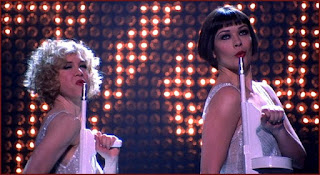
“Chicago” is a lively and brutally sardonic musical satire, set in the crime-ridden, corrupt Jazz Age of the 1920s.  Renee Zellweger is Roxie Hart, sentenced to Death Row for the murder of her lover. There, the star-struck show-biz wannabe meets her idol, Velma Kelly (Oscar-winner Catherine Zeta-Jones), a stage-musical sensation also on The Row for murder. While awaiting trial at Cook County Jail, they are supervised by the crooked matron known as Mama (Queen Latifah), and eventually become rivals as they vie for the attention of slick, on-the-take lawyer Billy Flynn (Richard Gere).

Most of the musical numbers take place in Roxie Hart’s imagination, in set-pieces staged within the jail.  They are beautifully precise, colorfully glitzy and elaborate, and make wry comments about the characters and their stories in contrast to the drab, gray world of the prison.  Rob Marshall directs with muscle, keeping the tone light and peppy, even mocking, as it flaunts graft and dishonesty and the way the press and the public eat it up. The pacing is quick, the performances strong. 

Marshall’s choreography is a clear tribute to the slinky, feline style of Bob Fosse.  Occasionally, though, he overdoes the cutting, especially in the opening number, “All That Jazz”.  Marshall intercuts effectively between Jones’ number and Zellweger’s crime scene, but edits his dancers’ intricate moves so much that we don’t get the full pleasure of the dance: it comes at us in pieces. (Compare this to Fosse’s screen versions of “Cabaret” and “Sweet Charity”: he teases us with long takes, and cuts with significance, before editing more quickly to build excitement.)

In the world of the film, everyone is corrupt.  Everyone lies, and it’s all just entertainment.  You can bribe your way out of anything, and the public will make you a hero. The press is an unwitting accomplice, spinning the narrative and creating a sensation, just to sell more papers.  The innocent who cannot pay for protection in the name of justice are simply allowed to die.  As Gere’s Billy Flynn says glibly, “That’s Chicago”.

Most of the characters have one big number that reveals their story, mostly with a heavy shade of irony. Queen Latifah’s Mama is an amusingly monstrous yet surprisingly nimble chorus girl, feathered and sequined, promising to be good to you if you return the favor (“When You’re Good to Mama”).  Catherine Zeta-Jones’ Velma performs the “Cell Block Tango” with other murderesses who convince us that their crimes were justified (“he had it coming”); while one, a meek European ballerina, can say only one English phrase in a vain attempt to save herself: “Not Guilty”.  Zellweger’s Roxie has several moments in the spotlight; my favorite is the quietly jazzy “Roxie”, accompanied by tuxedoed chorus boys, performed in a highly reflective stage. 

Roxie’s husband Amos (a somewhat miscast John C. Reily, who was everywhere in the early 2000s), a milquetoast who is powerless and invisible, has a nice moment as a sad clown (“Mister Cellophane”).  And Billy Flynn sings about doing what he does “for love”, while clearly doing nothing without a payoff (“All I Care About”).

The highlight is “We Both Reached for The Gun”, performed as a demented ventriloquist-and-marionette puppet show.  Flynn is the Master Puppeteer, controlling Roxie’s every move and response to questions from the press, whose strings Flynn also pulls.  Flynn lies for Roxie and  enhances her story to gain sympathy for her; and the press (Christine Baranski and crew) calls it “understandable”, turning her into a pathetic victim and a celebrity.  As a metaphor for the way the media have lost their way, spinning stories and accepting outright lies to appease their base, this scene in “Chicago” is both highly entertaining and infuriatingly relevant.


And then there’s “Razzle Dazzle”.

As Roxie’s trial approaches, she tells Flynn that she is afraid.  He tells her not to worry, that all of it-- the trials, the whole world-- is a three-ring circus. It’s all show business.

As the number unfolds, the song seems to have become the guiding principle of those at the highest levels of our government. We have come to a dangerous moment in our culture of celebrity, in which our leadership conducts business as if it were a pro-wrestling match, and a significant number of people love it:

“Give ‘em an act with lots of flash in it 

And the reaction will be passionate”

The lyrics kept reminding me that the ones on whom we rely for guidance and encouragement, in this time of crisis, see the pandemic as little more than an excuse to grab the spotlight, rally supporters, or campaign for office.  I won’t mention any names.

“Razzle dazzle ‘em

And they’ll never catch wise”

The daily health briefings during April, filled with misinformation, hubris, and insults, were dutifully covered by the press as though they were a daytime serial.

“How can they hear the truth above the roar?

Razzle dazzle ‘em and they’ll beg you for more.”

A carefully detailed government report about safely opening the country was shelved, and hidden from the public.   There is no trusted guidance or encouragement. There are only nasty diatribes at critics, and dangerous advice about unproven treatments, while most of us do our best to avoid a disaster.

“Long as you keep ‘em way off balance, How can they spot you’ve got no talents?

“…What if your hinges all are rusting?  What if you are in fact disgusting?”

The coronavirus seems to be hitting hardest in disadvantaged, minority communities; and among the neediest, like the elderly, the disenfranchised, and those with compromised health conditions.  Why would anyone push to prevent millions of fellow countrymen from having health insurance, especially in a time of such dire and widespread health concern?

“Though you are stiffer than a girder, They’ll let you get away with murder

Razzle dazzle ‘em, and they’ll make you a star”.

Good art, even popular art, speaks to us in more ways than might have been intended.  While “Razzle Dazzle” was probably meant as a charmingly cynical swipe at show business, it has suddenly become an unavoidable criticism against our leadership and our culture in the midst of a crisis. 

In the end, “Chicago” is a wildly entertaining film, one of the best movie musicals since the 1970s.  It is beautifully crafted and photographed, lovingly detailed, well-directed, tuneful and exciting. It won a Best Picture Oscar in 2002 over some strong competition (“The Pianist”, “The Hours”).  Above all, it is enjoyable simply  as a skillful work of musical cinema .  It also has some  sly commentary built into its very fabric, which gives its entertainment value a vital edge.


Tuesday, May 5, 2020

"The Normal Heart" (2014)

(This is the second in a 2-part review of narrative films about the social and political effects of AIDS. While the demographics are different—the Coronavirus is attacking an entire world while AIDS was then considered a disease of a maligned and marginalized minority--the feelings of uncertainty and desperation of the Covid-19 crisis parallel those of that grim period during the AIDS outbreak of the 1980s.)


“The Normal Heart”, the HBO film adaptation of gay activist and author Larry Kramer's 1985 play, can be seen as the dark companion piece to the 1989 film “Longtime Companion”.  The latter was the first mainstream American movie to tackle the AIDS crisis. Kramer’s play was one of the first ever produced about the crisis (“As Is” had its New York debut one month earlier).

While “Longtime Companion” examines the personal cost of AIDS and aims for the heart, “The Normal Heart” wants to make you angry.  It exposes the combined ignorance of the Government, the medical establishment, and even the gay community in the outbreak’s early years.

This film is a wake-up call.  An indictment.  A primal scream of condemnation against those who have looked the other way,  deliberately ignored the issue, or allowed people to suffer and die out of sheer hate and fear.

It is a warning against complacency, an urgent plea for caution and compassion, but also a shouted question about shutting down the personal lives of those whose freedom was hard-won.  As we watch "The Normal Heart" today, there is a needling reminder about the challenges faced by a world that wants to take back its life, even as it is being decimated by a coronavirus that remains a mystery.

Kramer’s autobiographical play chronicles the struggles of his alter-ego, a writer named Ned Weeks. “The Normal Heart” is a blast-furnace of Weeks' rage that sears us to our seat.  As difficult as this film is to watch at times, you just can’t look away.

We endure the struggles Ned faces: fighting the office of New York Mayor Ed Koch and the Reagan administration for recognition and funding; questioning the neglectfulness of the AMA and National Institutes of Health; persuading the gay community of the life-and-death scenario ahead; and clashing with his own brother for understanding; as he establishes the group that became The Gay Men’s Health Crisis.  All the while, he suffers the heartbreak of friends dying horrible deaths, and a bittersweet romantic relationship with a handsome, closeted New York Times reporter who will soon succumb to the virus.

The film is a potent and concentrated mixture of public policy, medical tutorial, and personal drama, spanning four years.  Like “Longtime Companion”, “The Normal Heart” begins with that ominous New York Times article of July 3, 1981, citing “Rare Cancer Seen in 41 Homosexuals”.  Weeks has become a notorious figure for publishing a novel that is critical of the rampant promiscuity and drug use among a large segment of the gay male population.  (Kramer suffered terrible ostracism after his novel “Faggots” was released.)  The Times article frightens him into action and activism. 

He finds an ally in Dr. Emma Bookner, who is treating many gay men, who have had multiple partners, for rare infections and diseases that a normal immune system would easily fight off.  She encourages Ned, bluntly, to “tell gay men to stop having sex.”  There is an immediate and angry reaction against this, for personal, emotional, and political reasons: not enough is known to take such a drastic measure; that promiscuity is a political right; that it will destroy the community and drive more men back into the closet. 

No one can quite believe that having sex might result in death.  It is like the ultimate quarantine.  Upon hearing this statement at the inaugural meeting for the new health advocacy group, some attendees, who endured a lifetime of pain just to have the courage to be with another man, walk out in disgust.  It is riveting and disturbing.  When Emma sees this, Ned tells her, “Welcome to gay politics.”

As a member of the gay community I could see every side of the issue.  I feel a similar sense of conflict and ambiguity about an indefinite social-distancing order, or the mandatory wearing of masks. I know they are necessary; but I feel panic at the thought  that favorite aspects of my life, while nothing as intimate as sex, but as simple as going to the movies or sharing coffee at a table with friends, may be gone or changed forever.   

There are hot-button issues that are as yet unresolved.  Ned’s brother, an otherwise loving and caring sibling, masks his homophobia by telling Ned that as a group, the gay community has a “dreadful image problem”. Ned, who is witness to some extreme behavior, can’t totally disagree, but demands that Ben sees him as his equal, or will stop speaking to him.  Political figures who might be instrumental in providing funding or influence are themselves closeted homosexuals and refuse to address the issue.  AIDS patients in crumbling hospital facilities can’t even get staff members to bring meals into their rooms, or have repairmen fix their televisions, out of irrational fear.

The movie escalates into scenes of unforgettable power, which had me shaken:

One of Ned’s friends (who is also Ned's nemesis at the GMHC), tells how he had to transport his dying partner, suffering from nausea and dementia, on a plane to Phoenix that nobody wanted to fly, among a group of horrified passengers that didn't want him there, to see his mother for the last time.  The hospital refused to issue a death certificate; the body is bagged and dumped in the trash outside, as his mother weeps in mourning.

Emma confronts a medical examiner, who tells her that her desperately needed research funding was not approved.  In a startling monologue of passionate intensity, she blames the NIH for delaying the application for funding, and for refusing to work with French scientists on a promising discovery, so that the Americans can “steal a Nobel Prize”.

Ned’s partner Felix is in the final stages of illness, covered with sores and crumpled on the floor.. He releases his pent-up fury at Ned, who lashes back at him, before a heartbreaking reconciliation; later, they hold an unofficial wedding ceremony at Felix’ deathbed.

Ned is a confrontive fighter while his group at GMHC prefers a more reasoned approach.  Mickey, Ned’s friend, a volunteer and health writer, suffers a breakdown, under extreme pressure for, among other things, the uncertainty of the virus, the possibility that everything he fought for as a gay man (like loving openly and without guilt) might turn out to be wrong, the myriad unproven theories (genetic predisposition, monogamy, “herd immunity”, sex, blood, drugs, poppers, etc. ) that lead nowhere, and the resentment of those in high places whom Ned has alienated.

Ryan Murphy directs a powerhouse cast, all of whom unleash torrents of emotion in their skillful rendering of Kramer’s remarkable, raw screenplay.  

As Ned, Mark Ruffalo channels his anger and pain to an extent that allows the viewer a vicarious release at the “idiots” who can’t see the disaster that is growing more tragic every day.  Ruffalo captures the relentlessness of Kramer's activism as Ned, and is able to convey subtle layers of hurt in private moments when he feels like an outsider. (Ruffalo would go on to another angry crusader in his role as a journalist in “Spotlight” the following year.) 

Alfred Molina, in a brief but memorable role as Ben, has the imposing presence and gentility of a brother who learns painful lessons in acceptance.  

Matt Bomer is especially fine as Felix.  This is more than a triumph of makeup effects; I have never seen Bomer so honestly emotional behind his normally cool countenance. 


Jim Parsons and Joe Mantello must be singled out. Parsons is Tommy, a wickedly funny but especially compassionate volunteer, who saves the Rolodex cards of friends who have died of AIDS; by the end, he has more than fifty.  Mantello as Mickey walks the fine line between being supportive and playing Devil's advocate. Mantello  portrays Mickey's breakdown with intensifying rage and confusion, in a scene  that can bring a viewer to tears.


The true revelation is Julia Roberts as Dr. Emma Brookner.  Emma is based on Dr. Linda Laubenstein, who made the earliest connection between Kaposi’s Sarcoma and AIDS, and dedicated her short life (she died at age 45) to HIV research. For a time she was the only doctor in New York who treated AIDS patients.  Roberts is tough, focused, angry, and competent as Emma, a character who suffers the effects of polio as a youngster and uses a wheelchair.  Robert’s unrestrained rage at the doctors who withhold her funding inspires awe.  I have never seen her so strong; you just believe completely everything she tells you.

One brief exchange between Ned and Emma speaks volumes about the AIDS crisis, the hope for a vaccine, and the world of uncertainty we face during the coronavirus pandemic:

Ned: What are we supposed to do…be with nobody, ever? Well, it’s not as easy as you might think.

Emma: …Polio is a virus, too. I caught it three months before the Salk vaccine was announced. Nobody gets polio anymore.

I want to believe that, if and WHEN a coronavirus vaccine is found, nobody will get Covid-19 any more.

For whatever reasons (the fact that HIV is a rapidly mutating virus, that is contracted much differently that respiratory or gastrointestinal viruses; or maybe a continuing stigma of HIV as a “gay” disease), there is still no AIDS vaccine.    

I am still hopeful that we can hold Covid-19 at bay, just like we did after the 1918 flu pandemic.

For a riveting dramatic film, one that will give voice to feelings of anger and frustration against the AIDS pandemic and the coronavirus crisis, I highly recommend “The Normal Heart”.

(The title comes from a poem by W.H. Auden, called "September 1, 1939", whose final line reads "We must love one another or die.")

Sunday, May 3, 2020

"Longtime Companion" (1989)

 (This is the first in a 2-part review of narrative films about the social and political effects of AIDS. I look at how feelings of uncertainty and desperation in the midst of today’s global pandemic recall the fear and loss of that grim period in the 1980s, especially for the gay community.)


“Do you remember when the world was 
Just like a carnival opening up?” --Zane Campbell, “Post Mortem Bar”

“Longtime Companion” is a gripping, personal story about the beginning of the AIDS crisis, and the physical and emotional toll it takes on a group of gay men and their friends during the 1980s.  The film, set on Fire Island and Manhattan, adroitly introduces us to its large, interconnected cast of young professionals, lovers, neighbors, and friends.  It recreates the mood and atmosphere of that wonderful moment when the gay community felt a liberating sense of pride and freedom, to explore their sexuality and their world more openly, just before tragedy struck. 

Willy (Campbell Scott), a shy newcomer and athletic trainer, is the audience’s surrogate. He revels in beachside parties with his fun-loving best friend John (Dermot Mulroney). Willy begins a tentative but lasting relationship with the gentle and bearded attorney, “Fuzzy” (Stephen Caffrey).  

Fuzzy’s close friend Lisa (Mary-Louise Parker) lives next door to an attractive gay couple: Howard (Patrick Cassidy), Fuzzy’s client, an up-and-coming actor on a daytime soap-opera; and Howard’s partner Paul (John Dossett), a business executive.   

David (Bruce Davison), the gregarious yet comforting big-brother figure to them all, is a wealthy, down-to-earth owner of the beach house where Willy and John spend the summer.  Sean (Mark Lamos), Paul’s lover, is a screenwriter who is responsible for the scripts on the soap opera in which Howard appears.

The film is structured in a series vignettes spanning nine years, from 1981 to 1989.   

As the film opens on July 3, 1981, the holiday atmosphere is interrupted by characters reading and reacting to a fateful New York Times article headlined: “Rare Cancer Seen In 41 Homosexuals”:

Doctors in New York and California have diagnosed among homosexual men 41 cases of a rare and often rapidly fatal form of cancer. Eight of the victims died less than 24 months after the diagnosis was made…… Doctors investigating the outbreak believe that many cases have gone undetected because of the rarity of the condition and the difficulty even dermatologists may have in diagnosing it.  In a letter alerting other physicians to the problem, Dr. Alvin E. Friedman-Kien of New York University Medical Center, one of the investigators, described the appearance of the outbreak as ''rather devastating.''…

The ominous article produces familiar reactions.  Some are dismissive, thinking it’s a fluke.  Others make light of it, jokingly pointing at imaginary purple spots on their friends’ bodies.  Some are mildly alarmed, wondering if they might have been exposed by a casual pickup in a bar, or by the use of amyl nitrate (poppers).  

No one is overly concerned.  Life is great, it’s a holiday weekend, and everyone feels carefree among friends and potential new lovers.

As each vignette fades to black, and the story follows subsequent years, these characters face illness, loss of livelihood, and loss of friends, moving through various stages of denial, compassion, and fear.
  
Willy’s friend John contracts pneumonia, and is thought to have a compromised immune system; he winds up on a respirator, alone and terrified.  Sean worries about a spot on his neck and night sweats; David rationalizes it all, hiding his fear of losing his partner: “You have always had that mole; you’re sweating because it’s hot and we have no air-conditioning; I haven’t had sex since our last trip, so it’s beyond the incubation period.” 

Early in the film, another friend, Michael (Michael Schoeffling), believes that AIDS is a function of negative thinking, while Lisa reminds him that it’s a virus that doesn’t consider attitude. Later, some of the characters volunteer for Gay Men’s Health Crisis, or deliver meals to the sick, or use their diagnosis to try to encourage others.

We care about these people, drawn into the inevitable pain of their stories.  The group gets smaller each year, and by July 1989, the final segment, only three remain.  They walk the beach, and speculate what might happen if there’s a cure.  “It will be like the end of World War II”, one of them predicts.  They fantasize a glorious reunion on the beach, embracing all of those who have died since the virus was first discovered.

This scene, scored to Zane Campbell’s plaintive eulogy, “Post Mortem Bar”, is both shattering and healing.  In retrospect, in the face of the current health crisis, it hits the perfect emotional notes,  mourning a life that seems to have been taken away  from us, while looking forward with some hope for a treatment in the near future. 

“Longtime Companion” is a film of depth that raises other  issues that were important to the emerging gay community.  

Sean writes a storyline for Howard in which his character shares the first gay kiss on daytime TV.  Howard worries that he will be typecast in gay roles and lose his career as a mainstream actor (a fear that is still prevalent in show business).  

The Reagan Administration is called out for its complacency, and for not even mentioning the word AIDS, even as thousands are dying.  

Gay men who finally found the courage to come out of the closet now confront a more insidious fear about entering same-sex relationships, or even touching one another.

As a twenty-something new to Phoenix in 1984, I was painfully ignorant of AIDS, until I went to a plasma center to earn a little extra cash. I was shown a placard that warned that anyone who was a "practicing homosexual" was not allowed to give their plasma. 

I had not put myself at risk. But soon I heard more and more stories about the disease, and conflicting accounts about what it was, and how it was transmitted.  Symptoms like rapid weight loss, rare skin cancers, and severe night sweats, worried me.  

The disease seemed to be infecting gay men, but it was unclear exactly how. I was in the process of coming out, and yet I was afraid of physical contact with anyone.  Any time I got a blemish on my skin, or lost a pound, or woke up in a typical Arizona summer sweat, I worried about my mortality. I ate to gain weight, a silly and unhealthy way to prove that I was not sick. There was no testing available, no cure, and no one was recovering.  

This movie brought back that whole scary time.  Living through the uncertainty of the coronavirus elicits the same feelings of fear that many of us felt having lived through the early days of the AIDS crisis. 

(Even now, the slightest dryness in my throat, or a single cough from a person nearby, can create suspicion. Am I sick? Is that person carrying the coronavirus? Was I exposed?  We make ourselves sick with worry, and there is little good information to reassure us.)

In portraying the confusion and shortcoming of a healthcare industry dealing with an unfamiliar and rapidly-growing epidemic, “Longtime Companion” has become chillingly familiar.  Doctors struggle to treat infections and illnesses that until then had been rare to nonexistent.  A patient (Robert Joy), frustrated by lack of attention, and scant information about his condition, rips his IV from his arm, bleeding with potential contagion.  Willy reacts in anger after visiting his best friend in the hospital, noting the lack of beds, and even the unavailability of blankets in the Emergency Room. These scenes used to make me feel sadness and disbelief; now they are infuriating. How little we have learned in the last thirty years.

The film also carries a unique perspective for those who have survived an epidemic like AIDS.  It is interesting to see how a lack of information resulted in panic and irrational application of preventative measures.  Before anyone knew about the sexual transmission of AIDS, visitors and hospital workers wore masks and hazmat suits.  Willy scrubs his hands and face desperately after kissing a sick friend on the neck and touching his arm.   After the mode of transmission is determined to be through sexual contact, a couple lie in bed together, terrified to touch one another: they sadly talk about being able to make love again, someday, "after we die".

In a fulm of average length, we are overwhelmed with emotions, incidents, and characters.  Each actor gives authenticity and life to his/her character.  Each vignette builds suspense and emotional release.  

Best of all is the famous “Let go” monologue  performed by Bruce Davison.  Trying to give final encouragement to a suffering partner, Davison avoids the histrionics that the scene might reasonably allow.  Instead, his pain is all the more heartbreaking for being held in check. 


Davison earned the film’s only Oscar nomination, as Best Supporting Actor.  In my estimation, the film deserved much more recognition, for all of its performances, for its screenplay by Craig Lucas, and for the superb direction by Norman Renee, who juggled a large cast and an array of complex plot developments into a smooth and compelling piece of cinema.  Norman Renee himself died of AIDS in 1996.   

"Longtime Companion" is a great film that has regrettably become almost impossible to find. If you do find it available, do anything you can to see it.

One thing has changed for the better since the era depicted in the film:  Before gay relationships were recognized as legitimate, and before same-sex marriage was even considered possible, obituaries for those who had died of AIDS referred to the surviving life-partner as a "longtime companion". 

That term is now, thankfully, obsolete.

Friday, May 1, 2020

Postscript to "The Haircut"

following up on my post from Saturday, April 25, 2020, titled,

"The Haircut"

Mark and I gave each other haircuts.
Not bad for the first time!  Excellent, in fact!
(Although at one point, Mark actually said "I think I'd better stop".)
Beaver and Wally would be proud.